
Research
Nonlinear interferometry with high-gain parametric down-conversion
Mahmoud Kalash, Sascha Agne, Ismail Barakat (collaboration with Norbert Lindlein, FAU and Farid Khalili, Russian Quantum Center)
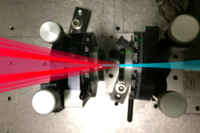
A nonlinear interferometer is a device where two nonlinear effects can enhance or suppress each other. For example, if parametric down-conversion occurs in each of the two successive nonlinear crystals, the nonlinear interference affects the mode structure of the output light. Moreover, the output light is very sensitive to the phase introduced between the crystals. This enables phase measurements with the accuracy exceeding classical limits.
Nonlinear optics and spectroscopy with bright squeezed vacuum
Paula Cutipa, Alexander Mikhaylov (collaboration with Tatiana Murzina and Denis Kopylov, Lomonosov Moscow State University)
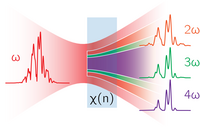
Bright squeezed vacuum is a quantum state of light that, among other features, has extremely strong and fast intensity fluctuations. This makes it very efficient for all multiphoton effects, including harmonic generation. We are using it as a pump in the generation of optical harmonics and supercontinuum. We see that it is by orders of magnitude more efficient than coherent light. In addition, similar to two-photon light, bright squeezed vacuum enables simultaneously high time and frequency resolution in multi-photon spectroscopy.
Nanoscale spontaneous parametric down-conversion
Tomás Santiago-Cruz, Vitaliy Sultanov, Michael Poloczek (collaboration with Frank Setzpfandt, Isabelle Staude, Thomas Pertsch, University of Jena, and Igal Brener, Sandia)
One of the current tendencies in photonics is miniaturization and integration of nonlinear optical devices. In this project, we generate entangled photons via spontaneous parametric down-conversion (SPDC) from ultrathin strongly nonlinear layers and metasurfaces. These novel SPDC sources will benefit from high second-order nonlinearity of various materials where phase matching is absent, as well as from shape resonances. The resulting sources will have not only small footprint, but also unprecedentedly high spatial and temporal entanglement, leading to subwavelength and subcycle photon correlations.
Generation of photon pairs in photonic-crystal fibres
Santiago Lopez Huidobro (with the group of Nicolas Joly (FAU) and the group of Philip Russell)

We aim at generating photon pairs through four-wave mixing in hollow-core photonic-crystal fibres filled with noble gas (xenon or argon). By changing the gas pressure, we can tune the wavelengths of both photons within an extremely broad range, covering more than two octaves and reaching the ultraviolet range on one side and the infrared range on the other side.
Novel ultrathin materials for SPDC
Vitaliy Sultanov, Tomás Santiago-Cruz, Sascha Agne (collaboration with the group of Vojislav Krstić, FAU)
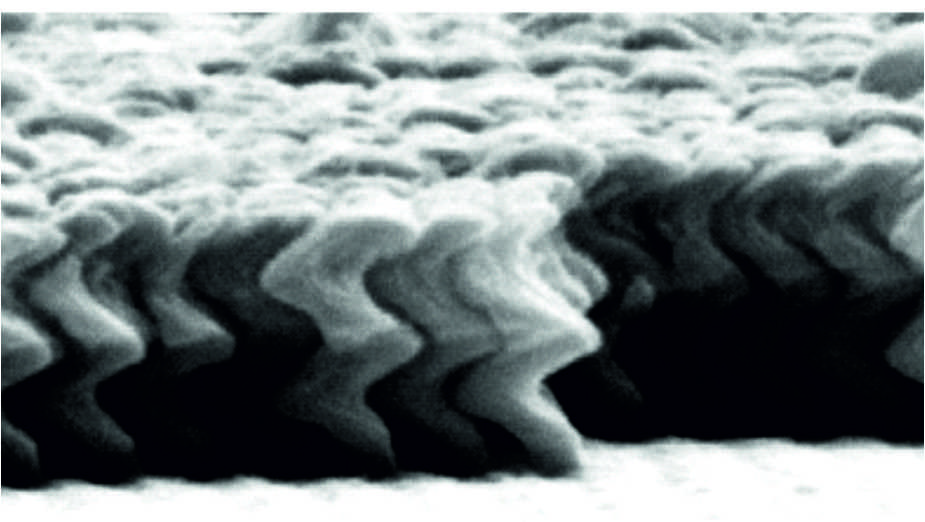
Continuing our experiments with nanoscale SPDC, we are looking for other ultrathin sources for generating entangled photons. Here, instead of using natural nonlinear materials, we would like to construct one ourselves. Our FAU collaborators fabricate a ‘forest’ of closely packed silicon and germanium nanohelices forming helical metafilms. Due to the 3D chirality of the helices and the cooperative interaction between their electrons, we expect to get a giant second-order susceptibility. Together with additional spatial modulation, this structure promises to provide a new controllable and versatile source for SPDC.
Generation of photon triplets
Changjin Son (with the group of Nicolas Joly, FAU, and the group of Philip Russell; collaboration with Yuri Kivshar, Australian National University)
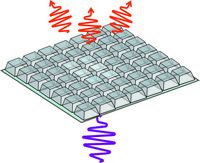
Our target is a new quantum effect, third-order parametric down-conversion: direct decay of a high-frequency photon into a photon triplet. It can take place in any third-order nonlinear material but we think that the best candidates are (i) submicron fibre tapers immersed into high-pressure gas for tuning the phasematching, (ii) ultrathin strongly nonlinear layers, and (iii) resonant metasurfaces with high third-order susceptibility. The latter two do not need any special measures to satisfy the phase matching, due to their extremely small thickness.
Lossless filtering of a single frequency mode of multimode light

If a source of radiation, classical or quantum, is multimode in frequency, how can one filter out a single mode without introducing losses or admixing other modes? So far, no efficient solution has been implemented. We are going to do it using a dispersive element and the projective operation of a planar waveguide.
DFG project CH 1591/9-1
Fiber source of entangled photons with giant tunable frequency separation (with N. Joly, 2020-2022).
Joint project DFG-RFBR CH 1591/2-1
Multi-photon nonclassical states of light based on high-gain parametric down-conversion
DFG project CH 1591/3-1
Generation of photon triplets via three-photon parametric down-conversion
PPP Tschechien 2017 (Projekt-ID: 57319488)
Homodyne detection of macroscopic quantum states of light
Bright Squeezed Vacuum and its Applications, 2013-2016 (BRISQ2)

FP7 project Bright Squeezed Vacuum and its Applications "BRISQ2", 2013-2016, was coordinated by our group.