

Welcome to the Nano-Optics Division
The nano-optics division at MPL strives to advance experimental and theoretical mastery of light-matter interaction at the nanometer scale. We deal with objects on the scales of single molecules, proteins or viruses. Our research portfolio encompasses a wide spectrum of scientific questions with the emphasis currently on the two key areas of nano-quantum-optics and nano-bio-photonics. A feature common to our research fields is that they typically address the condensed phase with a considerable degree of complexity.
Our research group takes up the challenge of designing projects and developing measurement strategies enabling a quantitative understanding of these complex systems in an elegant manner. The group was originally founded in 1997 at the University of Konstanz, where we pioneered the combination of concepts from quantum optics, laser spectroscopy, cryogenics, optical imaging, nanotechnology, and scanning probe technology. After ten productive years of research at ETH Zurich, we moved to MPL in Erlangen in 2011.
In September 2017, we organized a symposium to celebrate 20 years of nano-optics as an overarching research area dedicated to the interaction of light and matter at the nanometer scale. At this event, we interviewed sixteen pioneers who contributed to the development of the field. We have created a video highlighting how nano-optics emerged as a field and what its future challenges might be (click here to watch the video). The individual interviews are also available via our institute video depository.
Nano-Quantum-Optics
Over two decades of investigating fundamental optical processes at the single photon and single emitter level, we have pioneered the demonstration of efficient coupling between light and single quantum emitters without the need for cavities or antennas. We also demonstrated one of the very first and most quantitative cases of radiative enhancement by a plasmonic nanoantenna. Most of our work concerns solid-state samples and single organic molecules, however our findings are often generalizable to other systems such as atoms, ions, quantum dots, or color centers. Currently, our group is concerned with the realization of a controlled number of interacting quantum emitters, photons and phonons.
Nano-Bio-Photonics
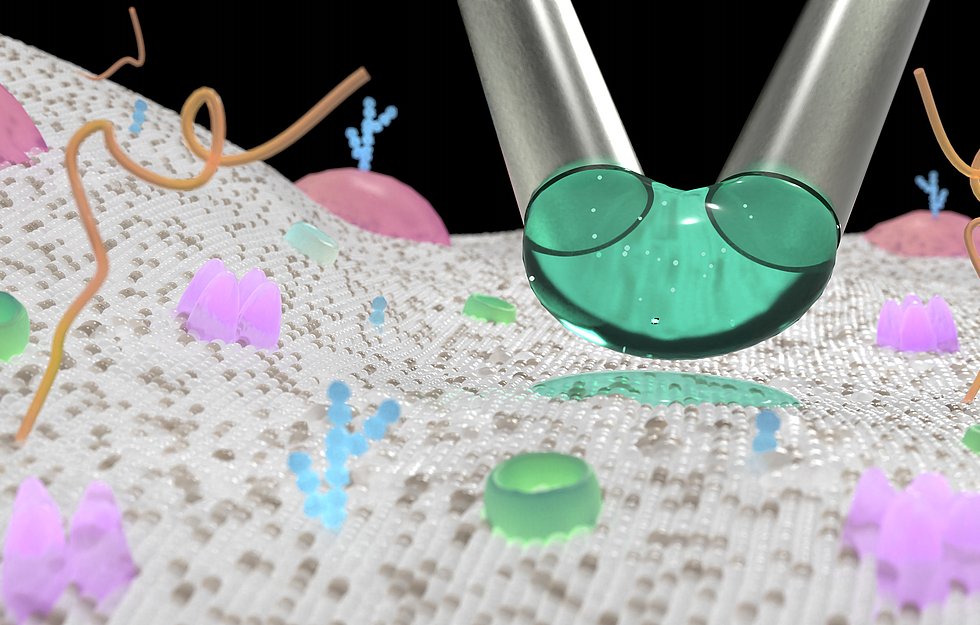
In our nano-bio-photonics branch, we exploit our expertise to perform novel forms of microscopy and to develop platforms for controlled experiments in the area of biophysics and fundamental medical research. Here, we are particularly interested in quantitative understanding of the interaction between individual viruses, vesicles and proteins with cells and tissues. Two important techniques developed in our lab are
1) interferometric scattering (iSCAT) microscopy and
2) cryogenic super-resolution microscopy.
We collaborate with many biologists, biophysicists and physicians around the world.
For more information, please see our publications list and the highlights section of this website.
Contact
Nano-Optics Division
Prof. Vahid Sandoghdar
MPI for the Science of Light
Staudtstraße 2
91058 Erlangen
+49 9131 7133-301
Director Professor Vahid Sandoghdar